
Orion 2024
Published:
The Great Orion Nebula
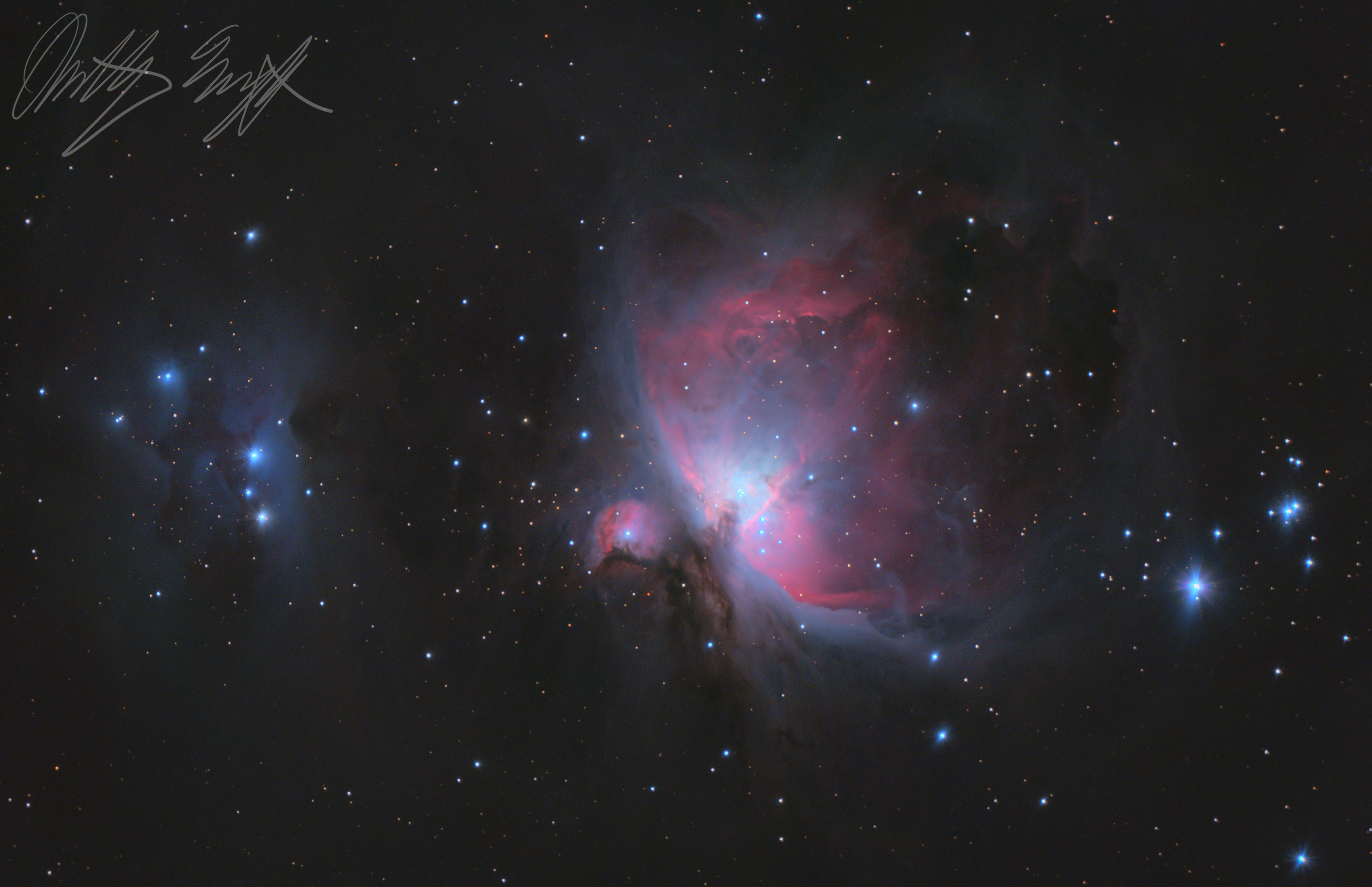
The Great Orion Nebula is one of the brightest regions in the Milky Way, bright enough to be viewable by the naked-eye at a dark site. At the core of the nebula lies a collection of four young stars, aptly named the Trapezium Cluster after the trapezoidal arrangement of cluster’s four brightest stars. The nebula is illuminated through a combination of reflecting and absorbing/re-emitting light originating from Trapezium. The nebula on the right of this image is affectionately known as the “Running Man Nebula”, it is illuminated through the reflection of light emitting from hot, young, blue stars.
This project was quite the headache to actually complete; my initial goal was to use short exposures rather than long-exposures so that Trapezium would not be saturated. I also wanted a wide field of view to capture the Running Man; I decided to use a Newtonian Telescope which was mounted on an Alt-Az mount. The winning exposure time was approximately five seconds; but the long readout time of the camera meant that a significant fraction of my time on-sky was dominated by the readout period. Moreover, the field rotation means that individual diffraction spikes rotate between the exposures, producing the widened diffraction spikes.
Due to the significant overhead incurred during readout, this project took three nights to complete and amounted to a measely eight-hours of data. However, the short exposures resulted in an incredibly high dynamic range which left even the brightest stars unsaturated.