About Me
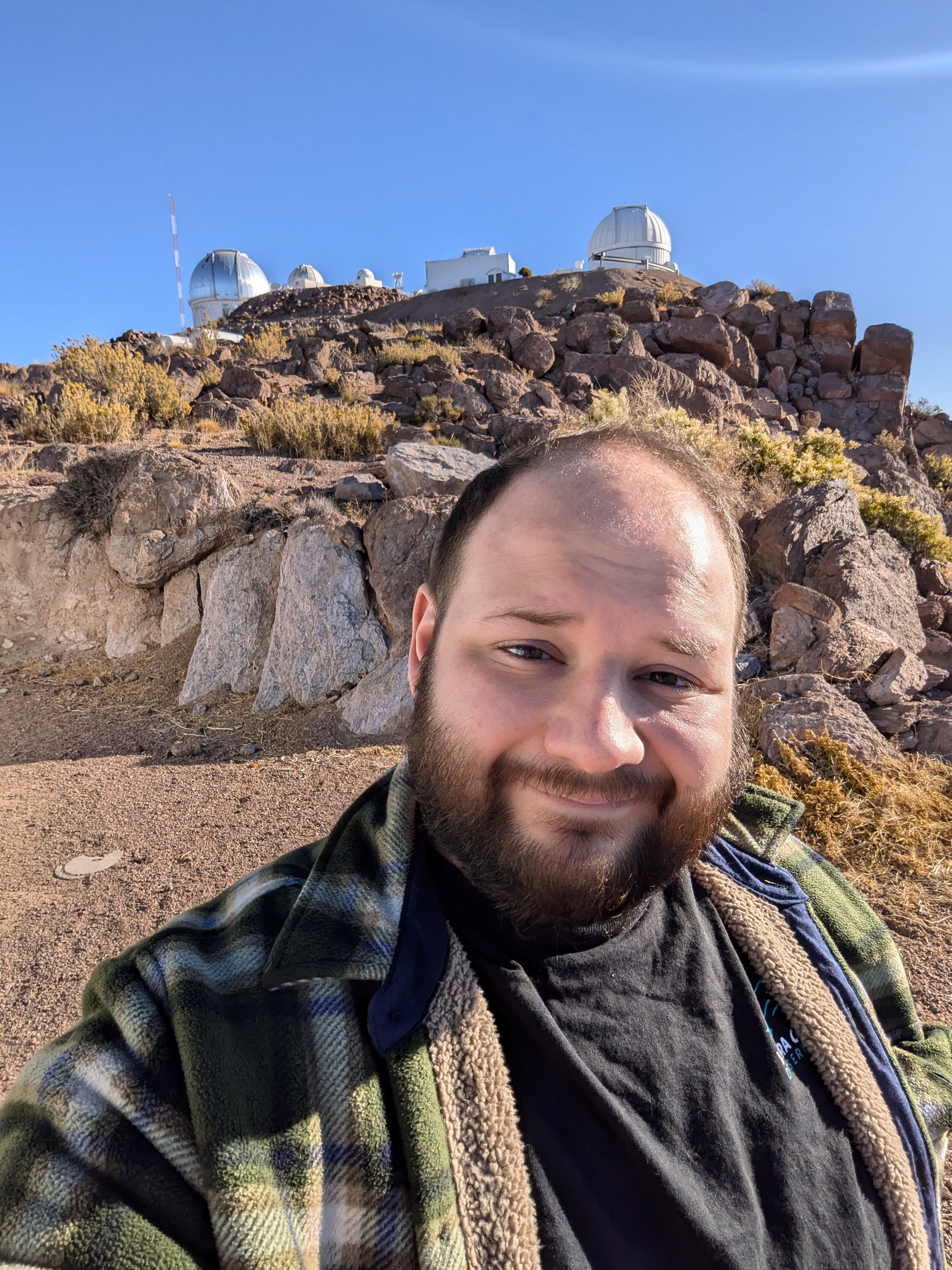
Hello! My name is Anthony M. Englert, I am an Observational Astronomer currently working as a postdoctoral scholar at Brown University.
My research concerns the general properties of galaxy clusters, with the long-term goal of ensuring that our understanding of galaxy clusters is sufficient for the next generation of dark energy surveys. This requires addressing several fundamental questions including:
Are the assumed relations between a cluster’s mass and another observable correct?
How do cluster properties evolve with the Universe?
What cluster properties drive systematic errors in cluster cosmology? How can we correct for them?
To address these questions, I support extensive surveys of galaxy clusters which span wide mass ranges, most notable is my ongoing support of the Local Volume Complete Cluster Survey (LoVoCCS), which covers all clusters with \( M_{200} \gtrsim 2.5\times 10^{14} M_{\odot} \) in the local volume (\( 0.03 < z < 0.12 \)). My primary role in LoVoCCS is leading the survey’s optical data reduction from raws to lensing-ready science products; this resulted in the creation of lovoccs_pipe, a pipeline powered by the LSST Science Pipelines which walks a user through our survey’s data reduction. The pipeline is hosted on GitHub and is described in the collaboration’s latest publication. I have am currently leading several observational campaigns to follow-up on particularly unique clusters, including a dedicated survey of several nearby superclusters, spectroscopic observations to better understand the composition of “blue wispy” features uncovered by LoVoCCS obsercations, and using medium-band filters to explicitly quantify the impact of preprocessing on a small sample of LoVoCCS clusters. To directly support next-generation dark energy surveys, I am currently a member of the LSST Dark Energy Science Collaboration, the Rubin Operations team, and the Roman Science Collaboration.
In addition to my research as a professional astronomer, I enjoy carrying out astrophotography with my DSLR camera and a small collection of telescopes. I regularly participate in outreach events and coordinate with the press to highlight new discoveries and encourage scientific thinking through astronomy.