
Triangulum 2023
Published:
A deep image of the Triangulum Galaxy, one of the nearest galaxies to our own.
Triangulum
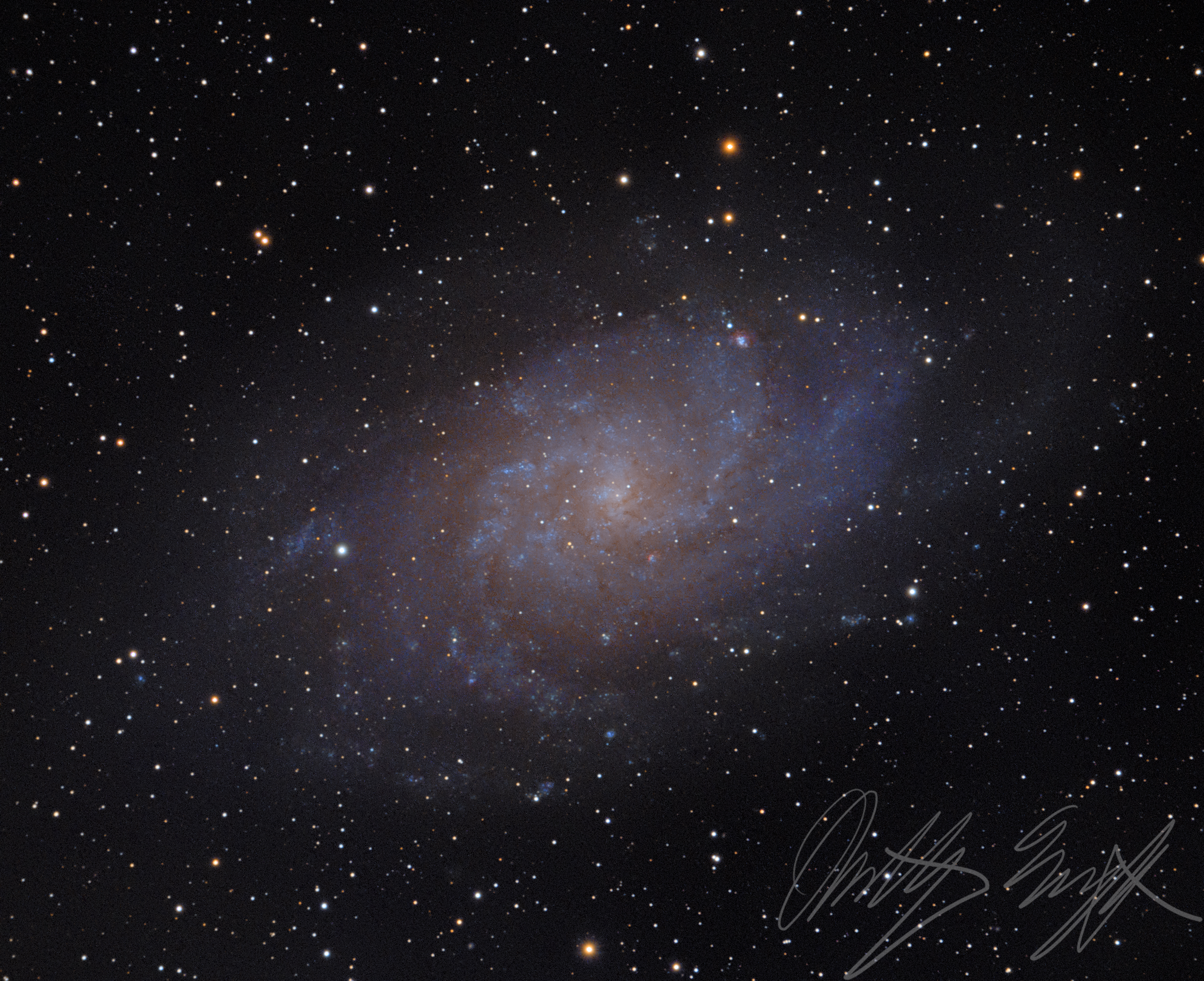
The Triangulum Galaxy is located in the constellation Triangulum (Latin for triangle, named after three bright stars forming a triangle); it is the second-nearest galaxy at a distance of \(\sim 883\text{ kpc}\) (\(\sim 2.9\) million light-years) and is composed of \( \sim 10^{40} \) stars. Being a member of the Local Group, Triangulum is due to collide with the other members within the next \( \sim 150 \) billion-years, producing one massive elliptical galaxy.
This image was captured over three nights, combining over eight hours of data, using a Canon EOS Ra DSLR Camera. Preserving the outer rings of the spiral is particularly challenging; for this reduction, I extracted a luminance image in addition to the standard RGB chanels, and reduced each separately. This makes it significantly easier to preserve those bright features, as the luminance channel effectively computes an average of each channel.
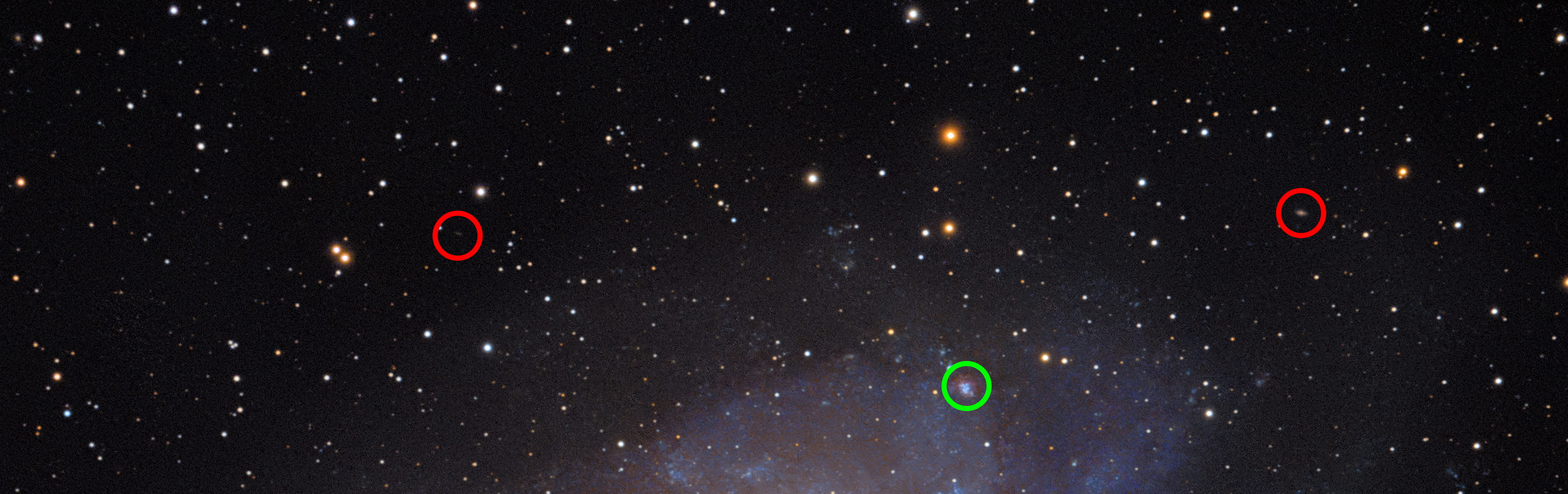
Tucked away behind the stellar streams are two background galaxies with ``creative’’ names: SDSS J013506.69+302413.5 on the left and LEDA 5899 (circled in red). These background galaxies are at least \( 100\times \) further than Triangulum and are \( 10^4\times \) fainter. Circled in green is a pronounced HII region (known as NGC 604); this is encased in a red envelope from the re-emission of light absorbed by nearby Hydrogen, while the core is blue due to the ongoing star formation within it.